TL;DR: Website Management Has Changed
- Modern business websites are no longer just marketing tools — they are operational systems with legal, security, privacy, and compliance risk.
- Fixing issues only when something breaks is no longer enough. Most serious website problems develop quietly, without visible errors.
- Laws change. Browsers update. Vendors modify tools. Plugins age. Risk accumulates even when a site appears “fine.”
- At a certain level of complexity, businesses outgrow reactive webmaster support focused on fixes and content updates.
- What’s required instead is ongoing digital oversight — clear ownership of website risk, compliance, platforms, vendors, and connected systems.
- The Executive Webmaster Partnership exists to fill this gap, providing executive-level responsibility for keeping digital systems aligned, stable, and protected over time.
Why “Webmaster” Is No Longer Synonymous With Fixes and Web Content Updates
For many business owners, the word webmaster still means one thing:
someone who fixes things when they break and updates content when requested.
That definition made sense years ago.
Today, it is incomplete – and increasingly risky.
Fixes Solve Symptoms. Oversight Prevents Damage.
When websites were simple, reactive support was enough.
A page went down, a link broke, a plugin failed – and someone fixed it. The website functioned primarily as a digital brochure, and ongoing involvement was minimal.
Content updates were also the primary ongoing need.
New pages, updated text, refreshed images. That was the bulk of what most businesses required, and a webmaster’s role naturally centered around execution.
That environment no longer exists.
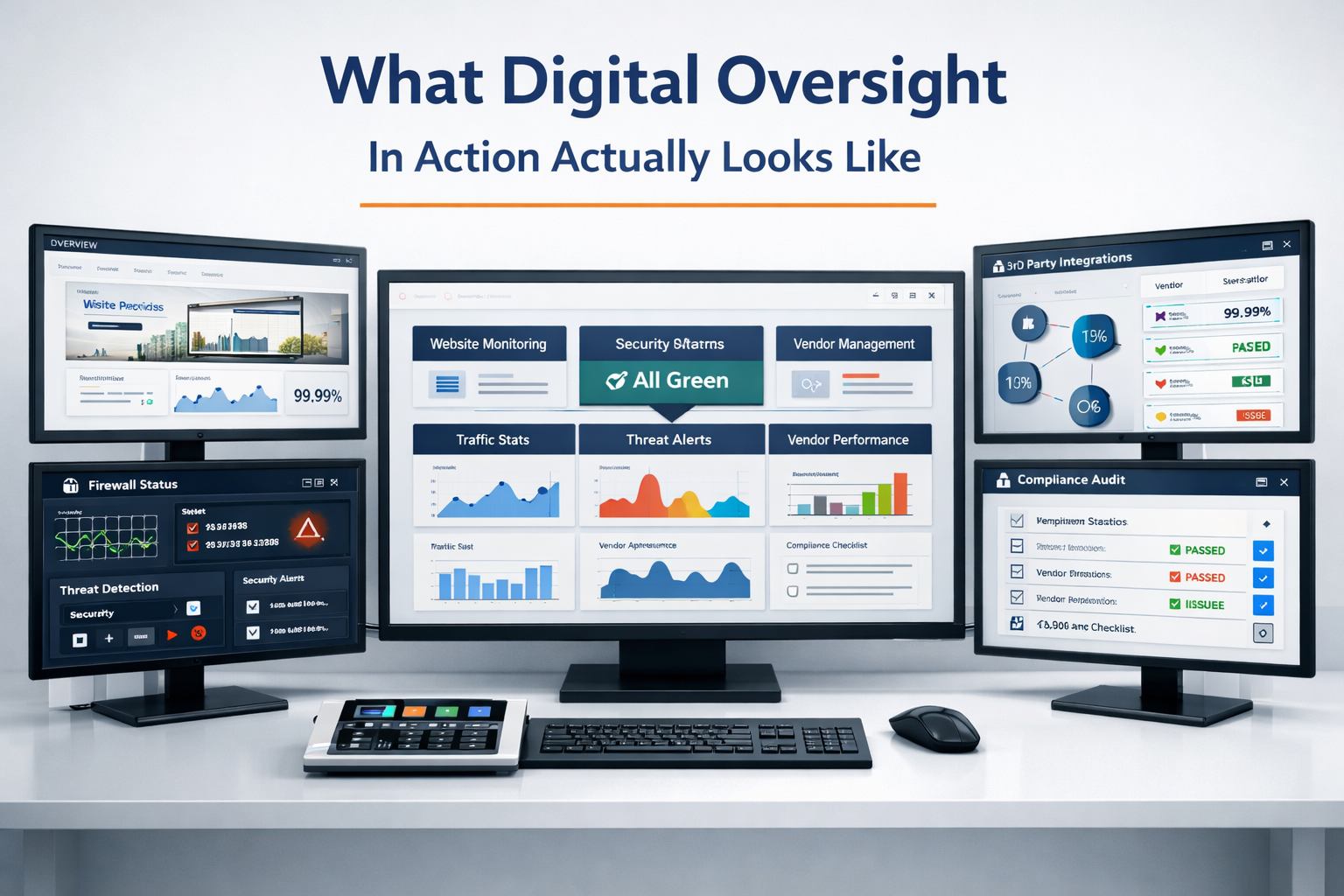
Modern business websites are complex systems.
They interact with browsers, platforms, vendors, regulations, and third-party services.
Much of that interaction happens silently, without visible errors or obvious warning signs.
As a result, risk now exists even when nothing appears “broken.”
A website can load perfectly, pass a surface-level check, and still:
- Collect data improperly
- Fail accessibility requirements
- Expose security vulnerabilities
- Create legal liability for the business owner
None of those issues trigger a “fix request.”
They exist beneath the surface.
Why the Old Definition Creates Real Risk
The traditional webmaster model is reactive by design. It waits for a symptom:
- A broken feature
- A reported error
- A visible malfunction
But most modern website failures are not technical failures first.
They are compliance failures, governance failures, or oversight failures.
Accessibility issues do not always show up as broken pages.
Privacy violations do not announce themselves with error messages.
Security risks often come from tools that are installed, trusted, and functioning exactly as intended.
In other words, the absence of visible problems does not mean the absence of risk.
This is where the definition of “webmaster” breaks down.
A role focused solely on fixes and content updates assumes that:
- Problems will be obvious
- Risks will announce themselves
- Action will be triggered automatically
That assumption is no longer valid.
Websites Have Shifted From Assets to Exposure
Today, a business website is not just a marketing asset.
It is an operational system with legal, financial, and reputational exposure.
Changes in laws, browser behavior, platform policies, and third-party vendors can introduce risk without any action taken by the business owner. A site that was “fine” six months ago can quietly fall out of compliance or best practice simply due to external change.
This shift is why the old definition of a webmaster is no longer sufficient.
Fixes are still necessary.
Content updates still matter.
But they are downstream activities, not the role itself.
The modern need is not someone who reacts when something breaks.
It is someone who actively watches what could break, what could expose risk, and what requires attention before damage occurs.
That difference – between reacting to symptoms and preventing damage – is the foundation for everything that follows.
From Reactive Support to Ongoing Digital Oversight
Why the Traditional Webmaster Model No Longer Works for All Businesses
The traditional webmaster model has not become useless.
It has become situational.
For some businesses, reactive website support is still appropriate and cost-effective. Smaller organizations with limited digital exposure, minimal third-party tools, and low regulatory risk may not need ongoing digital oversight. In those cases, a webmaster who handles fixes and content updates as needed can be a practical solution.
The problem arises when that same model is applied to businesses whose websites have quietly outgrown it.
When the Traditional Webmaster Model Does Work
A reactive webmaster model may still be sufficient for businesses that:
- Have a very simple website
- Collect little to no user data
- Use few third-party tools
- Operate in low-risk or lightly regulated environments
- Accept downtime or delays as part of doing business
In these situations, the website functions more like a static presence than an operational system. The risk profile is lower, and the cost of oversight may outweigh the benefit.
For those businesses, reactive support is not a failure.
It is a fit.
When the Traditional Model Starts to Break Down
As businesses grow, their websites tend to accumulate complexity gradually, not intentionally.
More plugins are added.
Analytics tools are installed.
Chat systems, forms, integrations, and marketing scripts are layered in.
Content expands. Vendors change. Platforms update. Laws evolve.
At some point, the website stops being “just a website” and becomes a digital system that:
- Interacts with privacy and accessibility laws
- Relies on third-party vendors for core functionality
- Handles customer data, inquiries, or transactions
- Represents meaningful legal and reputational exposure
This is where the traditional webmaster model begins to fail — not because the webmaster is ineffective, but because the role itself is no longer sufficient.
Reactive support assumes:
- Risks will be visible
- Problems will be reported early
- Fixes can be applied without consequence
That assumption does not hold for businesses operating at scale or under regulatory scrutiny.
The Gap Is Not Skill. It’s Scope.
The shift from reactive support to oversight is not about skill level or competence.
It is about scope of responsibility.
Fix-based models focus on execution after an issue is identified.
Oversight models focus on ownership before issues surface.
For businesses with:
- Ongoing compliance exposure
- Multiple vendors and tools
- Customer data responsibilities
- Brand and legal risk at stake
Waiting for something to “break” is no longer a reasonable strategy.
At that point, the question is no longer “Can someone fix this?”
It becomes “Who is responsible for making sure this doesn’t happen?”
That distinction is where the traditional webmaster model reaches its limit — and where ongoing digital oversight becomes necessary.
Signs You’ve Outgrown Reactive Website Support
Many businesses don’t realize they’ve outgrown reactive website support until small issues start piling up. If any of the following sound familiar, you’re likely past the point where “call someone when it breaks” is enough.
You may have outgrown reactive support if:
- Your website has been redesigned more than once, and the same plugins were carried forward each time without a full review
- You’ve received an accessibility complaint, warning, or demand letter – or worry you could
- You’re unclear what data your website collects, where it’s sent, or which tools are still active
- You’ve said “I should really have someone look at that” about your website more than once this year
- Updates, renewals, or compliance tasks live in your head instead of a system
- Nothing is broken – but nothing feels fully under control either
Introducing the Executive Webmaster Partnership (Ongoing Digital Oversight)
The Executive Webmaster Partnership was created to address a gap that exists for many established businesses:
the absence of clear ownership over ongoing digital risk, compliance, and platform decisions.
Most organizations have people who do website work.
Few have anyone who is responsible for watching the entire digital landscape and acting before problems surface.
That is the role this partnership fills.
What the Executive Webmaster Partnership Is
The Executive Webmaster Partnership is an ongoing digital oversight role.
It focuses on:
- Monitoring risk across the website and connected systems
- Evaluating changes in laws, platforms, vendors, and tools
- Prioritizing what actually needs attention
- Taking action before issues become legal, financial, or reputational problems
This is not a project-based engagement.
It is a long-term responsibility designed to provide continuity, context, and accountability.
The goal is not to react faster when something breaks.
The goal is to reduce how often things break at all – and to prevent the kinds of issues that never announce themselves until damage has already occurred.
What This Partnership Is Not
To avoid confusion, it is important to be clear about what this role is not.
The Executive Webmaster Partnership is not:
- A bundle of fixes
- A content update service
- Emergency-only website support
- A plugin installation or monitoring tool
- A replacement for marketing strategy or creative services
Fixes and updates may still happen, but they are outcomes of oversight, not the purpose of the role.
Fixes vs Oversight: A Fundamental Difference
Fixes respond to symptoms.
They are triggered when:
- Something breaks
- Someone complains
- An error becomes visible
Oversight operates earlier in the timeline.
It looks for:
- Emerging compliance risks
- Quiet changes in third-party behavior
- Vendor or platform decisions that introduce exposure
- Misalignment between tools, laws, and business practices
This distinction matters because most serious website issues do not begin as technical failures.
They begin as unmonitored change.
Oversight exists to notice those changes and address them before they escalate.
Why an Executive-Level Role Is Required
For many businesses, this role fills the gap left by not having a Chief Internet Officer — someone responsible for aligning internet-based systems, tools, and risk with business objectives.
Digital risk does not fit neatly into one department.
It touches:
- Legal compliance
- Technology decisions
- Vendor relationships
- Internal workflows
- Public-facing content
Without a defined owner, responsibility becomes fragmented.
Tasks get handled, but oversight does not.
The Executive Webmaster Partnership exists to provide that ownership.
It is designed for businesses that recognize their website is no longer just a marketing asset, but an operational system that requires active governance.
This partnership takes responsibility for the digital considerations business owners should not have to track themselves – so decisions are made deliberately, risks are addressed early, and the website remains an asset rather than a liability.
Ongoing ADA Risk Monitoring for Business Websites
ADA website compliance is often treated as a one-time project, but in practice it’s an ongoing risk. Accessibility changes as websites evolve – new content is added, layouts shift, technologies update, and plugins change behavior. A site that was compliant at one point can drift out of compliance without any obvious signal.
This risk is not hypothetical. A small number of law firms actively target non-compliant websites, and small to mid-sized businesses are frequent targets precisely because ongoing monitoring is rare. Many claims are triggered not by intent, but by neglect – sites that haven’t been reviewed since their last redesign.
The real cost of an ADA website lawsuit goes well beyond the initial notice. Attorney fees, settlements, and rushed remediation under legal pressure often cost significantly more than proactive oversight would have. At that point, timelines and priorities are no longer under your control.
Accessibility plugins alone do not solve this problem. Overlays do not correct underlying structural issues, and even when they help temporarily, routine content updates can reintroduce accessibility failures. Without continuous monitoring and ownership, risk quietly rebuilds in the background.
Cookie Consent Enforcement Oversight
Cookie notices alone are no longer enough to manage privacy risk. Many tools successfully display consent banners but do not actually prevent data collection. In some cases, tracking begins before a visitor has granted consent, creating exposure even when a notice is technically present.
This matters more now than it did even a few years ago. As of 2025, nearly twenty U.S. states have enacted comprehensive privacy laws, each with its own requirements. While the specifics vary, enforcement trends are consistent: regulators and plaintiffs focus less on what a website says and more on what it does. Actual data collection behavior matters more than disclosure language alone.
Cookie compliance is also not static. Laws continue to evolve, enforcement patterns shift, and third-party tools change how they behave over time. A setup that was compliant at one point can quietly drift out of alignment as scripts update, vendors change defaults, or new tracking tools are added.
Without ongoing oversight, businesses often assume consent is being handled correctly when it isn’t. Risk accumulates invisibly until it’s flagged by an audit, a complaint, or a legal notice.
Third-Party Script Governance and Data Collection Risk
Many common website tools introduce data collection risk without drawing attention to themselves. Analytics platforms, chat tools, advertising pixels, and embedded widgets often collect data automatically as soon as a page loads, regardless of whether a business intended that behavior.
These tools are frequently installed to solve a specific problem – tracking traffic, improving support, testing ads – and then left in place for years. Over time, businesses lose visibility into what scripts are active, what data they collect, and how they interact with consent and privacy requirements.
Script oversight matters because data collection does not require active use. Even dormant tools can transmit information in the background. Without governance, compliance failures happen silently, not because of misconduct, but because no one is actively monitoring behavior as tools update and regulations evolve.
Ongoing oversight provides a layer of accountability. It ensures third-party scripts are reviewed, understood, and aligned with current privacy expectations before they become a source of hidden exposure.
Website Security and Vulnerability Awareness
A website that appears to be working is not necessarily secure. Many vulnerabilities originate from trusted vendors, not from obvious misconfiguration or neglect. Plugins and third-party tools can introduce risk even when they are fully functional and regularly updated.
Security issues often surface through supply-chain weaknesses, delayed patches, or changes in how updates behave over time. These risks are easy to overlook because nothing breaks immediately. The site loads, features work, and problems remain invisible until an incident or alert forces attention.
Ongoing security awareness means paying attention to how tools evolve, not just whether they function today. Without active oversight, vulnerabilities accumulate quietly, turning routine updates and dependencies into sources of preventable exposure.
Plugin and Vendor Necessity Reviews
Every plugin and vendor added to a website increases complexity. Even well-maintained tools introduce additional attack surfaces, dependencies, and update paths that must be monitored over time.
Most websites accumulate plugins and vendors incrementally – a tool added to solve a temporary problem, another added during a redesign, others carried forward without review. Over time, necessity is replaced by habit, and the site becomes more fragile than it appears.
Ongoing oversight shifts the focus from accumulation to intention. Tools are evaluated based on whether they are still needed, still appropriate, and still worth the risk they introduce. Fewer, well-understood tools generally mean fewer points of failure and less exposure overall.
Digital Processes and Internal Systems Oversight
For many established businesses, the website is only one part of a broader digital ecosystem. Intranets, document systems, access controls, and internal workflows often sit behind the scenes, quietly supporting daily operations. When these systems evolve without oversight, they can introduce hidden operational and security risk that isn’t immediately visible.
Internal tools can also create external exposure. Intranets and internal portals may be accessible more broadly than intended. Document systems such as SharePoint often carry permission structures that no longer reflect current roles or responsibilities. Over time, access control and visibility issues compound, increasing the risk of data leakage or misuse without anyone noticing.
Oversight also involves identifying what’s missing, not just what exists. Inefficient workflows, manual processes, and workarounds often signal opportunities for safer automation and clearer structure. Without someone regularly evaluating these systems, businesses tend to accept friction and risk as normal parts of operations.
Ongoing digital oversight brings intention to internal systems. It ensures tools, permissions, and workflows evolve deliberately, supporting the business instead of quietly undermining it.
Ongoing Remediation as Laws, Browsers, and Platforms Change
Compliance and security are not fixed states. Browser updates, platform changes, vendor policy shifts, and evolving legal requirements constantly change how websites and digital systems behave. What was acceptable or secure last year may no longer meet current expectations.
These changes rarely announce themselves in a way that feels urgent. Browsers update automatically. Platforms adjust defaults. Vendors revise policies. Laws evolve quietly until enforcement catches up. Without active oversight, systems fall behind incrementally rather than failing all at once.
Ongoing remediation ensures digital systems adapt as conditions change instead of drifting out of alignment. It shifts responsibility from reacting after something breaks to maintaining continuity and stability as the landscape evolves.
Website SOPs and AI Usage Guidelines
As websites become more complex, undocumented procedures create risk. Content publishing, accessibility checks, and privacy or security considerations are often handled inconsistently when standards live only in people’s heads. Without documented digital procedures, even routine updates can introduce avoidable compliance or quality issues.
AI usage adds another layer of responsibility. Tools used for website content, automation, or decision support need clear guidelines around when they should be used, how outputs are reviewed, and who is accountable for the final result. Without governance, AI-generated content can introduce inaccuracies, accessibility failures, or compliance gaps that are difficult to trace after the fact.
Ongoing oversight ensures that procedures are documented, followed, and updated as tools evolve. It creates clarity around both human and AI-driven workflows, reducing risk while preserving efficiency and consistency.
What Is the Executive Webmaster Partnership
The Executive Webmaster Partnership is a long-term digital oversight role designed for businesses whose websites have become operational, legal, and reputational assets.
This partnership is designed to be involved in business initiatives that affect digital systems, including new tools, workflows, platforms, and integrations. Involvement at the decision stage helps prevent costly rework, compliance gaps, and operational friction later.
It exists to provide clear ownership over the digital areas that most businesses manage reactively, inconsistently, or not at all.
Rather than focusing on isolated tasks, this partnership focuses on responsibility.
A Role – Not a Task List
Most website services are structured around actions:
- Fix this
- Update that
- Add a page
- Install a tool
The Executive Webmaster Partnership is structured around ownership.
That ownership includes:
- Monitoring ongoing digital risk
- Evaluating changes before they create exposure
- Prioritizing what actually matters
- Taking action deliberately, not urgently
Tasks still happen.
Fixes still occur.
Updates are still made.
But they are outcomes of oversight – not the purpose of the engagement.
Executive-Level Digital Responsibility
Digital risk does not sit neatly in one category.
It overlaps:
- Legal and compliance considerations
- Technology and platform decisions
- Vendor and software dependencies
- Internal workflows and documentation
- Public-facing content and data handling
Without a defined owner, these responsibilities become fragmented.
Different people handle pieces, but no one is accountable for the whole.
The Executive Webmaster Partnership exists to fill that gap.
It provides a single point of responsibility for monitoring, evaluating, and addressing digital issues before they escalate into larger problems.
Designed for Continuity, Context, and Prevention
This partnership is intentionally long-term.
Context matters.
History matters.
Understanding how decisions were made – and why – matters.
Oversight improves with time, not speed.
By maintaining continuity, the Executive Webmaster Partnership allows:
- Faster, more informed decisions
- Fewer reactive emergencies
- Reduced digital blind spots
- Greater alignment between business goals and digital execution
The goal is not to manage everything.
The goal is to manage what matters – consistently and responsibly.
The Executive Webmaster Partnership exists to take responsibility for the digital things business owners shouldn’t have to track themselves, so their website remains an asset rather than a liability.
Who the Executive Webmaster Partnership Is For (And Who It Is Not)
The Executive Webmaster Partnership is intentionally not designed for every business.
This is not because the work is exclusive or complex.
It is because not every organization has the same level of digital exposure, responsibility, or risk.
Understanding whether this partnership is a fit starts with understanding how your website functions within your business.
This Partnership Is Designed For
The Executive Webmaster Partnership is a strong fit for businesses that:
- Rely on their website as an operational system, not just a brochure
- Collect customer or user data through forms, analytics, or integrations
- Use multiple third-party tools, plugins, or vendors
- Operate in regulated or compliance-sensitive environments
- Have an established brand, client base, or public visibility
- Want problems prevented rather than fixed under pressure
- Value continuity, context, and long-term digital responsibility
These businesses recognize that digital risk does not announce itself clearly.
They want someone actively watching what could change, what could fail, and what requires attention before it becomes urgent.
For them, ongoing digital oversight is not a luxury.
It is a form of operational insurance.
This Partnership Is Not a Fit For
The Executive Webmaster Partnership is not a good fit for businesses that:
- Only need occasional fixes or content updates
- Are looking for the lowest-cost website support option
- Prefer one-off projects over ongoing responsibility
- Expect constant meetings or immediate responses
- Want marketing strategy, ad management, or creative direction
- Are comfortable reacting after problems surface
In these cases, a traditional webmaster or on-demand support model is often more appropriate and cost-effective.
This partnership is not designed to replace those options.
It exists alongside them, for a different level of need.
Choosing the Right Level of Website Support
There is no universal “right” website support model.
What matters is alignment between:
- Website complexity
- Business risk
- Regulatory exposure
- Internal capacity to monitor change
When a website carries legal, financial, or reputational responsibility, oversight becomes essential.
When it does not, simpler support models may be sufficient.
The Executive Webmaster Partnership is for businesses that have crossed that threshold – and want a defined owner responsible for keeping their digital systems aligned, compliant, and stable over time.
Moving From Reactive Fixes to Responsible Digital Oversight
Most website problems are not caused by neglect.
They are caused by unmonitored change.
Laws evolve. Browsers update. Vendors modify behavior. Tools introduce new risk. Content grows. Platforms shift priorities. All of this happens whether a business is watching closely or not.
Reactive fixes address issues after impact.
Responsible digital oversight works to prevent that impact from occurring in the first place.
For businesses whose websites carry legal, security, operational, or reputational responsibility, waiting for something to break is no longer a reasonable strategy. The cost of inaction is often far greater than the cost of prevention.
The Executive Webmaster Partnership exists for organizations that recognize this shift.
It is designed to provide:
- Clear ownership over digital risk
- Ongoing monitoring instead of periodic cleanup
- Informed decision-making rather than emergency response
- Continuity, context, and accountability over time
This partnership is not about doing more work.
It’s about taking responsibility for the right work – before it becomes urgent.
When your website is no longer just a marketing tool, but a system your business depends on, ongoing digital oversight isn’t optional. It’s part of operating responsibly.
Instead of wondering what you don’t know, you have someone whose job it is to know – and to quietly handle it, so you’re no longer carrying the invisible responsibility of watching for problems.
Not sure if your website has outgrown reactive support?
Request a brief fit conversation to determine whether the Executive Webmaster Partnership is the right level of oversight for your business. Complete the form to request a brief fit conversation.
Ready To Discuss Your Project?
Schedule time to connect and discuss your specific needs.